



The people behind the Courage practice.
Not a biography. A story of how a pattern became a research programme, a methodology, and a movement.
The story
Pattern. Research. Methodology.
How a recurring observation in working with leaders became a four-year study, a validated assessment, and a suite of programmes.
Phase 1
The Pattern
Two decades watching talented leaders stay silent when it mattered. Seeing the gap between what they knew and what they did. Not a character flaw — a structural problem that repeated across industries, cultures, and career levels.
Phase 2
The Research
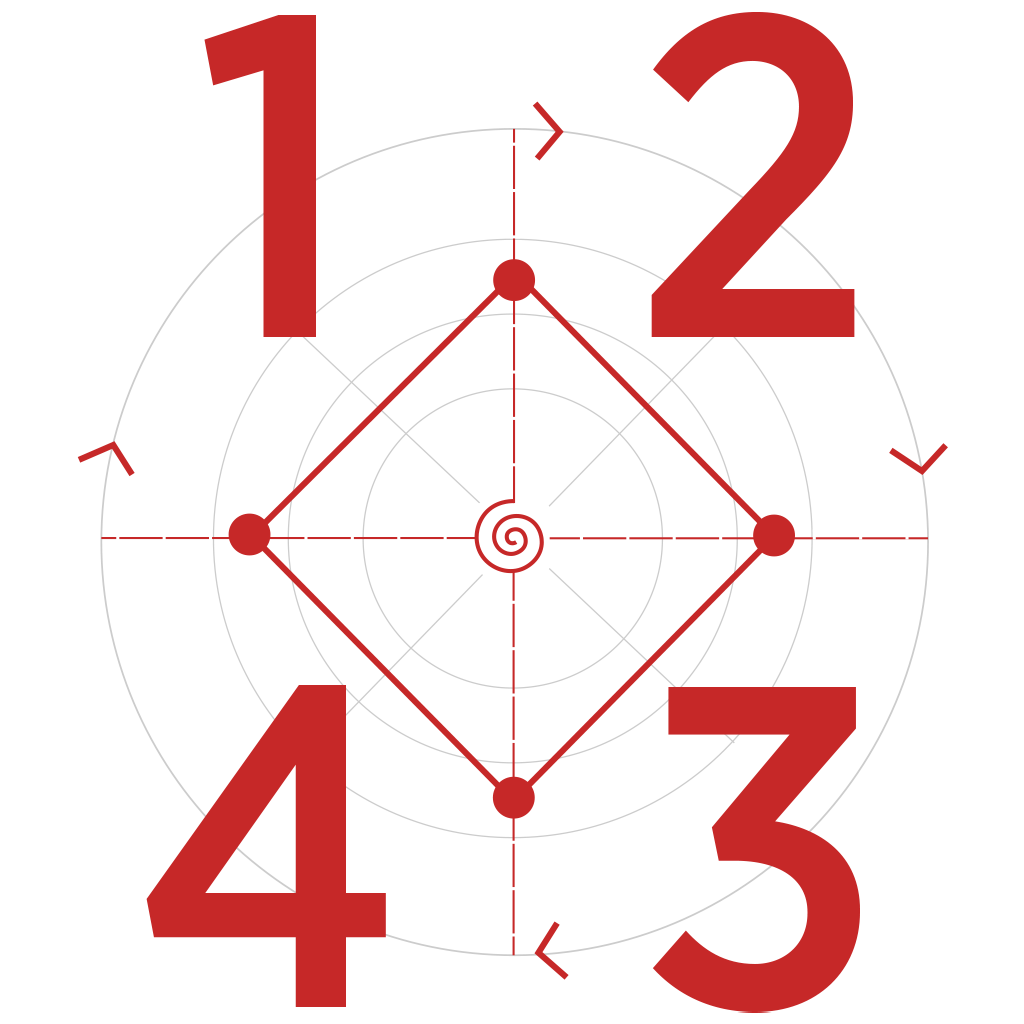
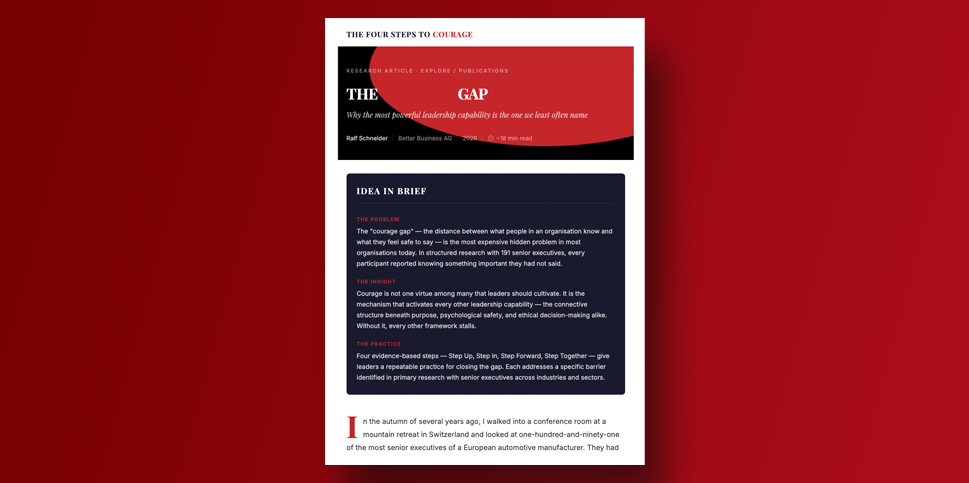
Over more than a decade of working with clients — C-suite executives, leadership teams, boards — the pattern kept appearing. What started as an observation became a research question. A four-year longitudinal study with 191 executives at a global European manufacturer. The findings confirmed what the experience had shown: courage is measurable, multi-dimensional, and developable. The Four Steps emerged from the data.
Phase 3
The Methodology
The research became a framework. The framework became an assessment — 48 questions, validated. The assessment became a suite of programmes and a growing community — designed to build courage as a deep personal practice, and to connect people around the need to bring more courage to where it matters.
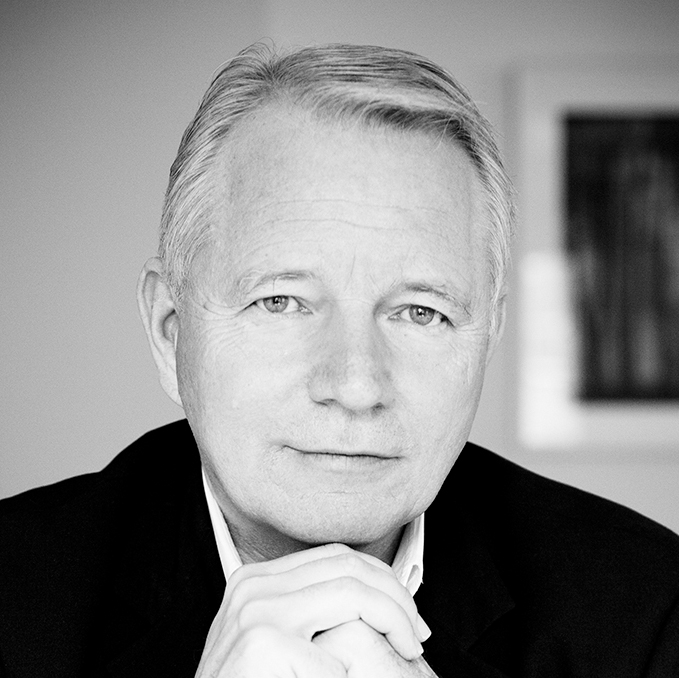 Ralf Schneider
- Founder, Better Business AG, Zürich
- Chairman, Digital Circles AG
- Author & Speaker — Courage & Leadership
- Advisor to boards and leadership teams
- Former Global Partner, PwC — Head of Talent & Leadership
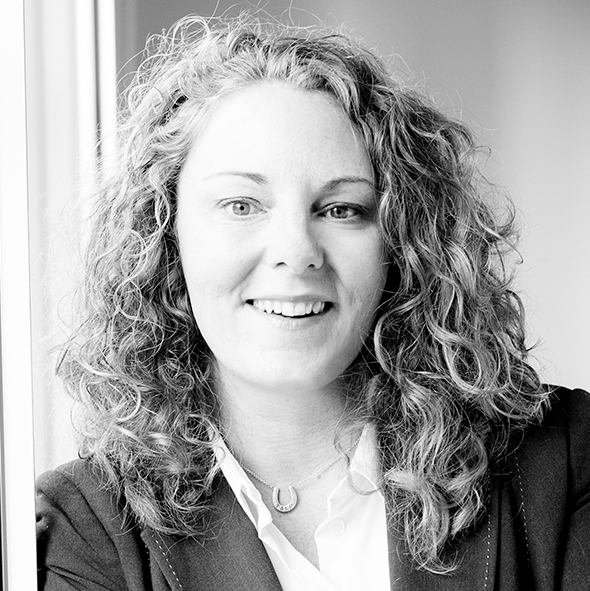 Isobel Dent
- Senior OD practitioner, Better Business AG, Zürich
- Courage Consultant & Coach, Digital Circles AG
- Expert — Courage & Culture
- Advisor to boards and leadership teams
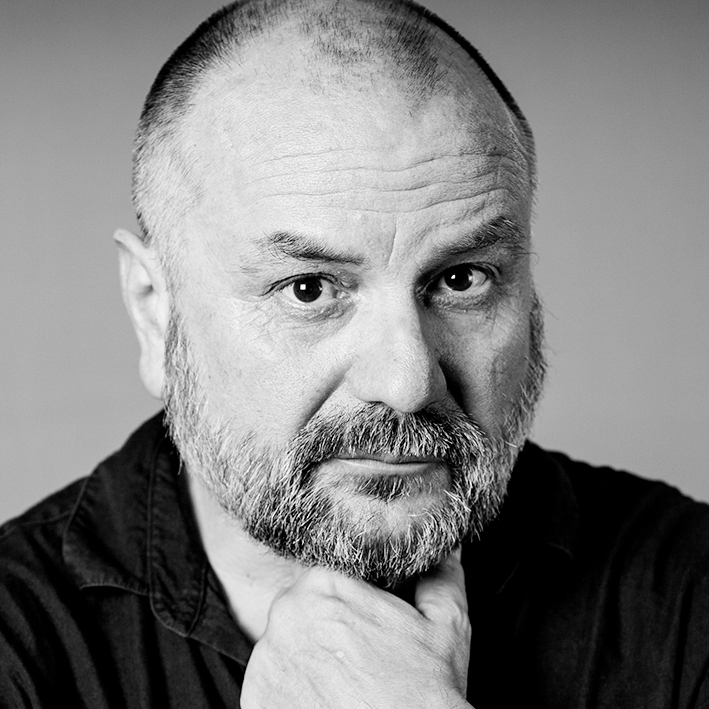 Martin Gent
- Courage Catalyst
- Expert — Courage, Innovation and Change
- Programme & Design Lead — Courage Workshops
- Experiencial Learning
What We Believe
01
02
03
Three convictions
The intellectual positions that shaped the research — and that the research, in turn, confirmed.
01
Courage is a capacity, not a trait.
Most people believe you either have courage or you don’t. The research says otherwise. Courage is a composite of measurable dimensions — each of which can be assessed, practised, and developed. It is closer to a practice than a gene. And like any deep capacity, it responds to personal development, not just inspiration.
02
Context is the enemy of generalisation.
Generic courage advice fails because it ignores the conditions in which courage is needed. A CEO facing a hostile board requires something different from a middle manager challenging a budget decision. The methodology works because it starts with where you are — your role, your culture, your specific moment of truth.
03
The moment is never theoretical.
Courage is not measured in workshops or on surveys. It is measured in the seconds between recognising what needs to be said and deciding whether to say it. Every tool, framework, and programme is designed for that moment — the one where knowing is not enough, and only action counts.
The Deep Work
The deep work behind each step
Our research and practice draws on neuroscience, psychology, philosophy, organisational behaviour, behavioural economics, leadership, business, arts and performance practices, somatic work, and innovation — to go where surface methods cannot. The Four Steps organise this into four dimensions of courage, each one a lens into a different form of the gap.
Step Up
How the brain processes threat and reality avoidance. Why seeing clearly is harder than it sounds.
Step In
Defence mechanisms, identity protection, values under pressure. How blockers formed long before any leadership role show up as hesitation or silence when it counts.
Step Forward
Ethics under uncertainty. The tradition of acting before certainty arrives. Why moving forward without a complete map is not recklessness but responsibility.
Step Together
Group dynamics, psychological safety, collective responsibility. Making courage systemic — not dependent on one brave person.
Working together
How Ralf works
Three ways to engage — each designed for senior leaders and the organisations they run.

Individual coaching
6 or 12-session courage coaching. Starts with the full assessment. For C-suite and senior leaders ready to close their own courage gap.
- Full 48-question assessment
- Personalised courage profile
- 6 or 12 structured sessions
- Zürich, London, or virtual

Keynote & Advisory
Speaks on courage and leadership of the future to executive and board audiences. Advises organisations on building courage into leadership development at scale.
- Conference keynotes
- Board-level presentations
- Leadership development advisory
- Custom briefings

Organisation Programmes
Full suite of courage-building programmes for organisations: Courage Culture Assessment, Courage Workshop, Team Sprint, and Courage Quest.
- Courage Culture Assessment
- Courage Workshop (1–2 day)
- Team Sprint (4–6 weeks)
- Courage Quest (3–6 months)
Our team
The Courage Practice Network
The Four Steps methodology is delivered by a growing international network of senior consultants and accredited courage coaches. Each practitioner brings deep expertise in leadership development and is accredited on the courage method — ensuring consistent quality and rigour across every engagement. Here are some of the countries with practitioners in our network.
Join the Courage Practice Network
Are you an experienced executive coach or senior consultant? We are growing our international network of accredited practitioners in the Four Steps methodology. Bring courage-based development to your clients with a research-backed, validated approach.
The Movement
Courage is the work of our time.
A growing community of leaders who believe the gap between what we know and what we do is too costly to leave unaddressed — in leadership, in organisations, and in life. People who take the assessment, share their moments on the Courage Wall, join Courage Circles, and bring the practice into their teams and organisations. Not because it is easy. Because it matters.
If you recognise the gap — in yourself, in your team, in your organisation — you belong here. The work is personal. The journey is shared.