


What Four Years of Data Show
The Courage Gap
The gap between knowing and doing is not a metaphor. It is the most expensive distance in leadership, and we measured it.

What the courage gap is
Every leader knows the moment. The number in the forecast that carries more hope than evidence. The appraisal softened to keep the peace. The thing that needs saying in the meeting, and the meeting ends.
In each of these moments a leader knows what the situation requires, and doing it carries a personal cost: friction, exposure, standing alone. The courage gap is the distance between that knowing and that doing.
What four years of data show
From 2022 to 2025 we followed 191 senior executives through five cohorts at a global manufacturer. Each was rated by the people who worked with them, 1,868 observers in total, around ten per leader. Nobody scored themselves. Four courage behaviours explained 75.3 percent of the variation in rated organisational effectiveness. Observer-rated, correlational, one organisation. Said before you ask. And it held.
The courage gap itself has a number. 93.7 percent of the 191 leaders were rated stronger at bringing out the best in people than at long-term effectiveness.
Strong with people, weaker on lasting results. Relational capability outruns its conversion into outcomes, and almost nobody sees it happening, because everyone in the room is being perfectly pleasant.
And inside the data sits a twist. The two behaviours leadership development actually trains for, having a voice and committing to people, carried no separable weight of their own once the proactive pair was in the model. What predicted effectiveness was acting before certainty and sharing risk. The two we train for are the two that did not count.
What the courage gap is not
It is not psychological safety by another name. Safety is a condition; it lowers the price of speaking. It does not do the speaking. Organisations with excellent safety scores and silent meetings have exactly this delta: the conditions are right and the conversion is missing.
It is not only about speaking up. Half of the gap runs the other way: the opportunity nobody claimed, the idea never proposed because the case was not yet closed.
That half never reaches a risk register, because nothing visibly went wrong.
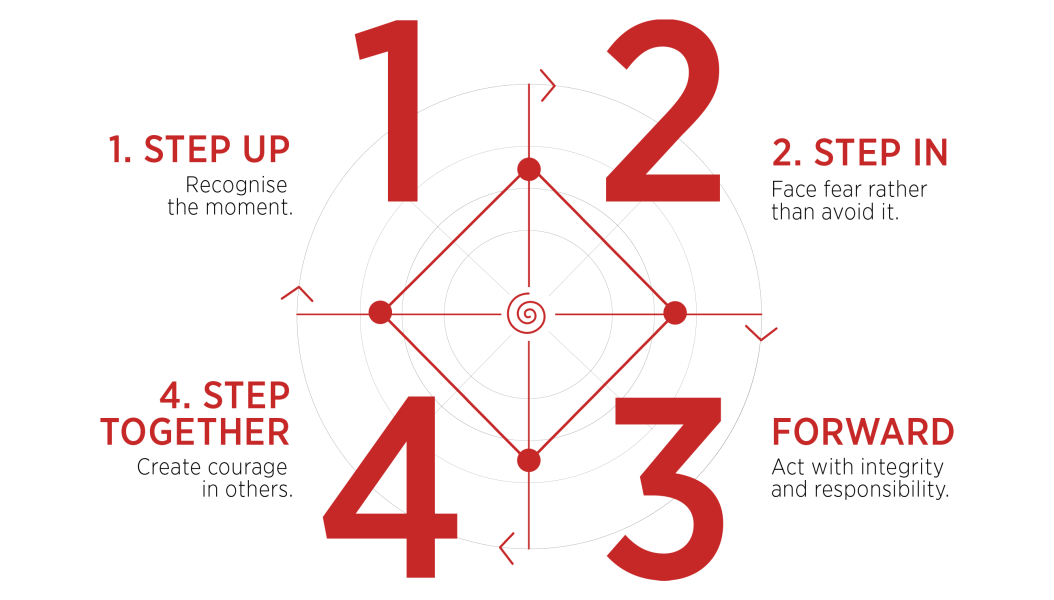
And it is not fixed. The four behaviours behind the numbers are ordinary enough to practise, which is what the Four Steps are for.
Where the gap lives in your calendar
The courage gap does not announce itself. It hides inside scheduled events: the January target-setting round, the talent review, the board pack, the customer who has grown too big to contradict.
Inside each sits a moment about two seconds long in which the useful thing to say or do carries a cost, and the gap opens or closes right there.